
Fluorosome-trans
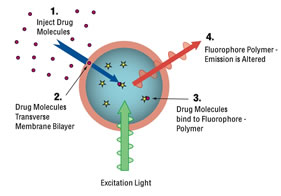
Fluorosome-trans are membrane bilayer vesicles containing hydrophilic, drug-sensing fluorescent probes in their aqueous interior. For example, for the product used to predict oral absorption - Fluorosome-trans-ent - the membrane consists of a consensus mixture of mammalian enterocyte lipids. The Fluorosome suspension can be prediluted and stored at room temperature for up to 3 months.
Addition of a test compound to a Fluorosome suspension results in a time-dependent quenching, which is curve-fitted to give a first order rate constant used in conjunction with the Fluorosome diameter to calculate the permeability, P, in cm/sec.
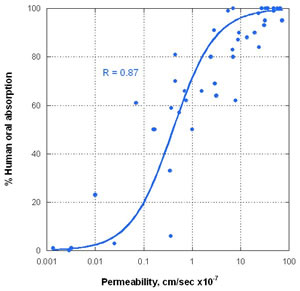
Figure 1. Correlation between oral absorption and Fluorosome-trans-ent permeability for 44 drugs.
Fluorosome-trans assay validation
Permeabilities of known drugs were determined with Fluorosome-trans-ent.
A plot of the results and published oral absorption data (Figure 1) demonstrates high correlation (R=0.87).
Published permeabilities derived from competitive assays, Caco-2 cell monolayers and PAMPA, have been compared with Fluorosome results. Caco-2 results are similar, although there are more outliers than with Fluorosomes. PAMPA results were poorly correlated and had more outliers than those obtained with Fluorosome-trans-ent.
Please download our Fluorosome Brochure or complete our Fluorosome Information Form to request further information.